
 See My Latest Article on HelloNation
Bodyweight training can build noticeable muscle when exercises are difficult enough, sets are performed close to muscular fatigue, and training progresses over time. A gym is not required, but bodyweight exercise does require thoughtful changes in leverage, range of motion, tempo, and weekly volume.
For residents of Atlanta, GA, bodyweight workouts can be especially practical because they can be performed in a living room, apartment, backyard, community green space, or shaded outdoor area. Warm, humid conditions may make outdoor sessions uncomfortable during parts of the year, so indoor training and careful hydration are often useful.
Can bodyweight exercises build muscle?
Yes. Muscle growth occurs when muscles are exposed to sufficient mechanical tension and recover with adequate food and sleep. Bodyweight movements create that tension by asking the muscles to control or move the body against gravity.
The main limitation is that bodyweight resistance can be difficult to measure precisely. A push-up, for example, does not use the entire body’s weight against the floor. The actual challenge changes with hand position, foot elevation, body angle, range of motion, and speed.
A beginner may gain muscle from standard push-ups and squats. Someone with several years of training may need harder variations, slower repetitions, unilateral exercises, or added external resistance to continue progressing.
Which bodyweight exercises are most effective for muscle growth?
The most useful movements cover the major muscle groups: chest, shoulders, arms, back, legs, and trunk. A balanced routine can be built around the following exercises.
Push-ups for the chest, shoulders, and triceps
Push-ups are a strong starting point for upper-body development. Keep the body in a straight line, brace the abdomen, and lower the chest under control rather than allowing the shoulders to collapse forward.
Useful progressions include:
- Incline push-ups for beginners
- Standard push-ups for general strength
- Close-grip push-ups for greater triceps involvement
- Feet-elevated push-ups for more shoulder and upper-chest demand
- Archer push-ups for advanced unilateral loading
Use a full, comfortable range of motion. If standard push-ups become easy, increase difficulty instead of performing extremely high repetitions with poor form.
Pull-ups and inverted rows for the back
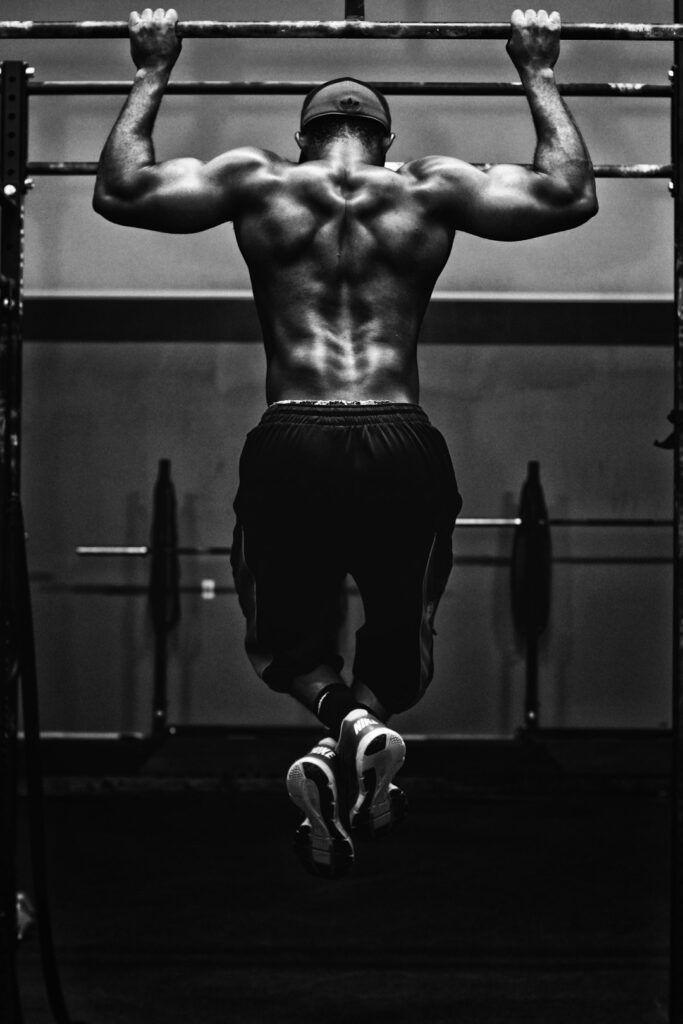
Pulling exercises are essential because pressing movements alone do not adequately train the upper back. Pull-ups and chin-ups develop the lat muscles, upper back, biceps, and grip.
A secure pull-up bar is necessary for home use. Do not use a loosely mounted bar or an unstable household structure. Beginners can start with controlled hangs, assisted repetitions, or slow lowering phases.
Inverted rows are another option when a stable horizontal bar is available. The body remains relatively straight while the chest is pulled toward the bar. Changing the body angle makes the movement easier or harder.
Squats for the thighs and glutes
Bodyweight squats train the quadriceps, glutes, and supporting muscles around the hips and trunk. Descend as far as can be controlled without pain, keeping the feet stable and the knees generally tracking in line with the toes.
Progressions include:
- Pause squats
- Tempo squats with a slow descent
- Split squats
- Bulgarian split squats
- Assisted single-leg squats
- Full single-leg squats for advanced trainees
Single-leg variations are particularly valuable because they increase the demand on each leg without requiring heavy equipment.
Hip hinges and bridges for the posterior chain
Glute bridges and single-leg bridges train the glutes and provide a manageable way to strengthen the hips. Squeeze the glutes at the top without arching the lower back excessively.
A bodyweight hip hinge can also be practiced by moving the hips backward while keeping the spine controlled. More advanced trainees may use single-leg Romanian-deadlift patterns, sliding leg curls, or Nordic hamstring progressions.
Hamstring training is often overlooked in bodyweight routines. Strong hamstrings support sprinting, jumping, stair climbing, and general lower-body function.
Lunges and step-ups for practical leg strength
Lunges train the legs one side at a time and challenge balance. Reverse lunges are often easier to control than forward lunges because they reduce the tendency to fall forward.
Step-ups can be effective when the platform is stable and the height is appropriate. The movement should be driven mainly by the working leg rather than by pushing forcefully from the trailing foot.
For residents in the city who walk frequently, climb stairs, or train outdoors, these unilateral exercises can improve strength that transfers well to everyday movement.
Pike push-ups for the shoulders
Pike push-ups shift more of the load toward the shoulders and upper arms. Start with the hips raised and the head moving toward the floor in front of the hands. Keep the movement controlled and avoid dropping heavily onto the head or neck.
As strength improves, the feet can be elevated. Handstand push-up progressions are advanced and should be approached gradually, with attention to wrist, shoulder, and neck control.
Planks and hanging leg raises for the trunk
Core training helps maintain position during pressing, pulling, squatting, and single-leg movements. Planks are useful when performed with active tension rather than simply holding the body still.
Other options include:
- Side planks
- Dead bugs
- Reverse crunches
- Hollow-body holds
- Hanging knee raises
- Controlled leg raises
The goal is not only to feel abdominal fatigue. The trunk should resist unwanted movement while the limbs produce force.
How many repetitions are needed for muscle growth?
Muscle can grow across a broad repetition range, provided the set is challenging and technique remains sound. A practical approach is to use roughly 6 to 20 controlled repetitions for difficult bodyweight movements. Easier exercises may require higher repetitions or longer sets.
Most working sets should finish with only a few good repetitions left. Stopping every set far from fatigue may not provide enough stimulus, while taking every set to complete failure can create unnecessary fatigue and reduce training quality.
For static exercises such as planks, use timed sets of about 20 to 60 seconds, increasing difficulty when longer holds become easy.
How should bodyweight training progress?
Progressive overload means gradually increasing the challenge placed on the muscles. With bodyweight exercise, progression can come from several sources:
- Moving from two-leg to single-leg exercises
- Elevating the feet or changing body angle
- Increasing range of motion
- Slowing the lowering phase
- Adding pauses at difficult positions
- Performing more repetitions with the same form
- Adding a set
- Reducing rest modestly
- Using a weighted backpack when appropriate

A weighted backpack should be secured, balanced, and introduced gradually. It should not interfere with posture or create pressure that causes pain.
Record exercises, repetitions, sets, and perceived difficulty. If the same workout feels easier for several sessions, make one small adjustment rather than changing everything at once.
What could a weekly routine look like?
A simple three-day schedule can train the full body without excessive complexity.
Day 1
- Push-ups: 3 to 4 sets
- Split squats: 3 sets per leg
- Inverted rows or pull-ups: 3 to 4 sets
- Glute bridges: 3 sets
- Planks: 3 sets
Day 2
- Pike push-ups: 3 sets
- Bulgarian split squats: 3 sets per leg
- Chin-ups or assisted chin-ups: 3 sets
- Single-leg bridges: 3 sets per leg
- Side planks: 2 to 3 sets per side
Day 3
- Feet-elevated or close-grip push-ups: 3 sets
- Reverse lunges: 3 sets per leg
- Rows or pull-ups: 3 sets
- Hamstring slides or controlled hinges: 3 sets
- Hollow-body holds: 3 sets
Leave at least one rest day between demanding full-body sessions. Walking, mobility work, or easy cycling can be performed on other days if recovery remains good.
What supports muscle growth besides exercise?
Training provides the stimulus, but recovery supports adaptation. Eat enough total food and include regular protein sources such as eggs, dairy foods, beans, fish, poultry, tofu, or other suitable options. Consistent sleep also matters; most adults benefit from approximately seven to nine hours per night.
Hydration deserves extra attention during hot or humid outdoor sessions. Train during cooler parts of the day when possible, take breaks, and move indoors if heat, dizziness, nausea, or unusual fatigue develops.
Joint pain is not a normal requirement for progress. Muscle effort and temporary fatigue are expected, but sharp pain, worsening pain, numbness, or loss of control are reasons to stop that movement and reassess technique or exercise selection.
Common mistakes that limit results
The most frequent problem is repeating the same easy routine for months. Bodyweight training works best when the exercises continue to become more demanding.
Other common mistakes include:
- Using partial repetitions to chase a higher number
- Neglecting pulling exercises
- Training hard every day without recovery
- Ignoring the legs because upper-body movements feel more interesting
- Changing routines too often to track progress
- Treating soreness as the only sign of an effective workout
A well-designed bodyweight program does not need to be complicated. It needs challenging movements, consistent practice, controlled technique, adequate recovery, and gradual progression.